
Home Loan Calculator for 700 Credit Score
Estimate how much you can borrow with a 700 credit score based on your financial situation. Lenders consider your income, debts, and estimated living expenses to determine your borrowing capacity.
Estimated Borrowing Capacity
$0
Based on your financial situation and Australian lender guidelines, you could potentially borrow between $0 and $0
Having a 700 credit score in Australia puts you in a solid position when applying for a home loan. It’s not perfect - that’s usually 750 or above - but it’s far from bad. In fact, many lenders see a 700 score as good, and you can still get approved for a decent mortgage. But how much can you actually borrow? That’s not just about your score. It’s about your income, your debts, your living expenses, and even the bank’s internal rules.
What Does a 700 Credit Score Mean in Australia?
In Australia, credit scores range from 0 to 1,200, depending on the bureau. Equifax and Experian use this scale. A 700 score falls into the good range. That means you’ve paid your bills on time, kept credit card balances low, and haven’t applied for too many loans in a short period. Lenders see you as reasonably reliable.
But here’s the thing: your credit score is just one piece of the puzzle. Banks don’t approve loans based on a number alone. They look at your entire financial picture. A 700 score gets you in the door. What happens next depends on your income, job stability, and how much debt you already carry.
How Do Lenders Calculate How Much You Can Borrow?
Most Australian lenders use a formula called the debt-to-income ratio and living expense assessments. Here’s how it works:
- Income: They look at your gross annual income - salary, bonuses, rental income, even Centrelink payments if they’re stable.
- Existing debts: Car loans, personal loans, credit card limits (even if you don’t use them), and other financial obligations.
- Living expenses: Banks use a standard figure called the H&H Living Expense Calculator, which estimates how much you spend on food, transport, utilities, insurance, and childcare. This isn’t your actual spending - it’s their benchmark. If you say you spend $800 a month on groceries, they might assume $1,200.
- Loan term and interest rate: A 30-year loan at 6.5% will let you borrow more than a 20-year loan at 7.2%.
For example, if you earn $85,000 a year, have no other debts, and live in Melbourne, a lender might approve you for a loan between $500,000 and $620,000. But if you have a $15,000 car loan and two credit cards with $8,000 limits, that number could drop to $420,000.
How Much Can You Borrow with a 700 Credit Score?
There’s no single answer. But based on data from Australian lenders in 2025, here’s a realistic range:
- Single income, no dependents, $70,000/year: $450,000-$550,000
- Single income, one child, $85,000/year: $500,000-$600,000
- Two incomes, $120,000 combined, no debt: $700,000-$850,000
- Two incomes, $110,000 combined, $20,000 in car debt: $600,000-$720,000
These numbers assume you’re putting down at least a 10% deposit. If you’re putting down 5%, lenders will be more cautious. Some might still approve you, but they’ll require Lenders Mortgage Insurance (LMI), which adds thousands to your loan.
What Lenders Care About More Than Your Credit Score
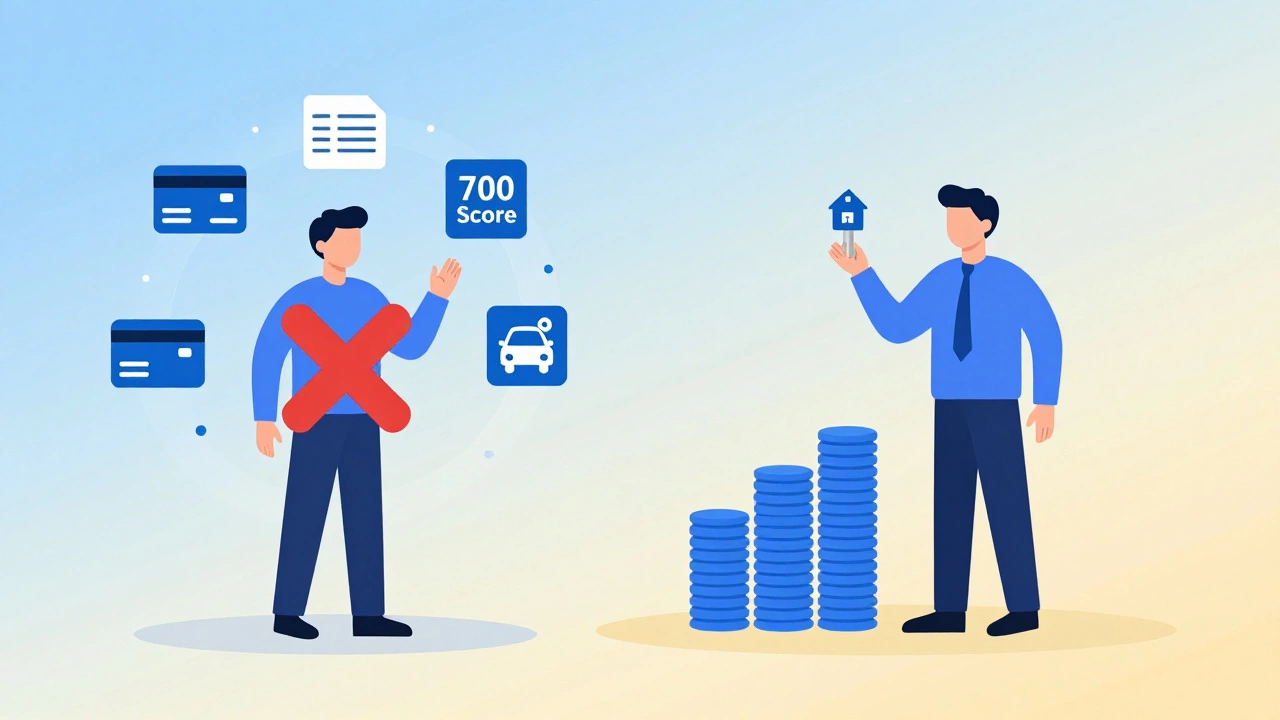
Here’s what surprises most people: lenders care more about your spending habits than your credit score. A 700 score with $12,000 in credit card debt and $200 a month in subscription services? That’s a red flag. A 680 score with no debt, a stable job, and $15,000 in savings? That’s a green light.
They also check:
- Job history: Two years in the same job? Great. Freelancer with inconsistent income? Harder.
- Savings history: Do you have three to six months of living expenses saved? That’s a strong signal.
- Loan applications: If you’ve applied for five loans in the last three months, lenders think you’re desperate or in trouble.
One lender in Melbourne told a client recently: “We don’t care if your score is 710 or 740. We care if you can prove you’ve been saving $1,000 a month for the last 18 months.”
How to Increase Your Borrowing Power
Even with a 700 score, you can boost your borrowing capacity. Here’s how:
- Pay down credit card balances. Even if you don’t use them, high limits count as potential debt. Lower them to under $1,000 each.
- Cancel unused credit cards. Fewer open lines = lower risk in the bank’s eyes.
- Save a bigger deposit. A 20% deposit removes LMI and gives you more leverage.
- Consolidate debt. If you have multiple small loans, roll them into one with a lower interest rate.
- Get a co-borrower. A spouse or parent with a strong income can help you qualify for more.
One couple in Geelong increased their borrowing power by $120,000 in six weeks just by closing two credit cards and paying off a $6,000 personal loan.

What If You’re Denied?
If you get declined, don’t panic. Ask the lender for the reason. Most will tell you. Common reasons:
- Too much debt relative to income
- Short employment history
- High living expenses (as estimated by the bank)
- Recent credit inquiries
Fix one thing. Wait three months. Apply again. Many people get approved on their second try - even with the same score.
Real-World Example: Buying a $650,000 Home
Sarah, 32, earns $78,000 a year in Melbourne. Her credit score is 705. She has a $12,000 car loan and $3,000 in credit card debt. She saves $1,200 a month.
Her bank ran the numbers:
- Income: $78,000
- Debt repayments: $320/month (car) + $150/month (credit cards)
- Estimated living expenses: $2,800/month
- Deposit: $65,000 (10%)
Result: She qualified for $590,000. She needed $650,000. So she increased her deposit to $100,000 by using savings and help from her parents. Now she’s approved for the full amount.
Her credit score didn’t change. Her financial picture did.
Final Thoughts: It’s Not About the Number
A 700 credit score is a good start. But it’s not the deciding factor. What matters is your ability to manage money over time. Lenders want to see consistency - steady income, low debt, and savings habits. If you’ve got those, you’ll likely borrow more than you think.
Don’t fixate on your score. Focus on your bank statements. Clean up your debts. Build your savings. Talk to a mortgage broker who knows how to present your case to different lenders. You don’t need a perfect score to buy a home. You just need a clear financial story.
Can I get a home loan with a 700 credit score and no deposit?
No, most lenders in Australia require at least a 5% deposit. Some government-backed programs, like the First Home Loan Deposit Scheme, allow 5% deposits without LMI - but you still need a minimum credit score of 650 and meet income limits. A 700 score helps, but you still need savings.
Does a 700 credit score get me the best interest rate?
Not always. The best rates usually go to borrowers with scores above 750 and larger deposits. With a 700 score, you’ll still get competitive rates - often around 6.2% to 6.8% in early 2026 - but you might not qualify for the lowest tier. Shopping around with a broker can help you find the best deal.
How long does it take to improve my credit score from 700 to 750?
It can take 3 to 6 months if you pay down debt, avoid new credit applications, and make all payments on time. Some people see jumps in as little as 30 days after paying off a credit card balance. But don’t rush it. Lenders prefer to see consistent behavior over time.
Do I need to use a mortgage broker if I have a 700 credit score?
Not required, but highly recommended. Brokers know which lenders are more flexible with scores around 700. Some banks are stricter than others. A broker can help you avoid multiple rejections and find lenders who value your savings history over your score.
Can I buy an investment property with a 700 credit score?
Yes, but it’s harder than buying your first home. Lenders treat investment loans as riskier. You’ll need a higher deposit (usually 20% or more), proof of rental income potential, and a stronger financial buffer. A 700 score is acceptable, but you’ll need excellent documentation to qualify.