
Commercial Property Valuation Calculator
Property Financials
Valuation Results
You own a building. You’ve got tenants paying rent. But when you ask, "What is this place actually worth?" the answer isn’t just about adding up monthly checks. It’s about understanding how much income that property generates over time and what buyers are willing to pay for that future cash flow. For many commercial owners, the concept of value feels abstract until they sit down with an appraiser or a broker who starts talking about "cap rates" and "net operating income."
Let’s cut through the jargon. The value of a commercial property-whether it’s an office building, a retail strip, or an industrial warehouse-is fundamentally tied to its ability to make money. Unlike your home, which might be valued based on what your neighbor sold theirs for, commercial real estate is a business. Its price tag is calculated using specific financial metrics. If you’re trying to figure out how much your asset is worth, you need to understand the math behind the market.
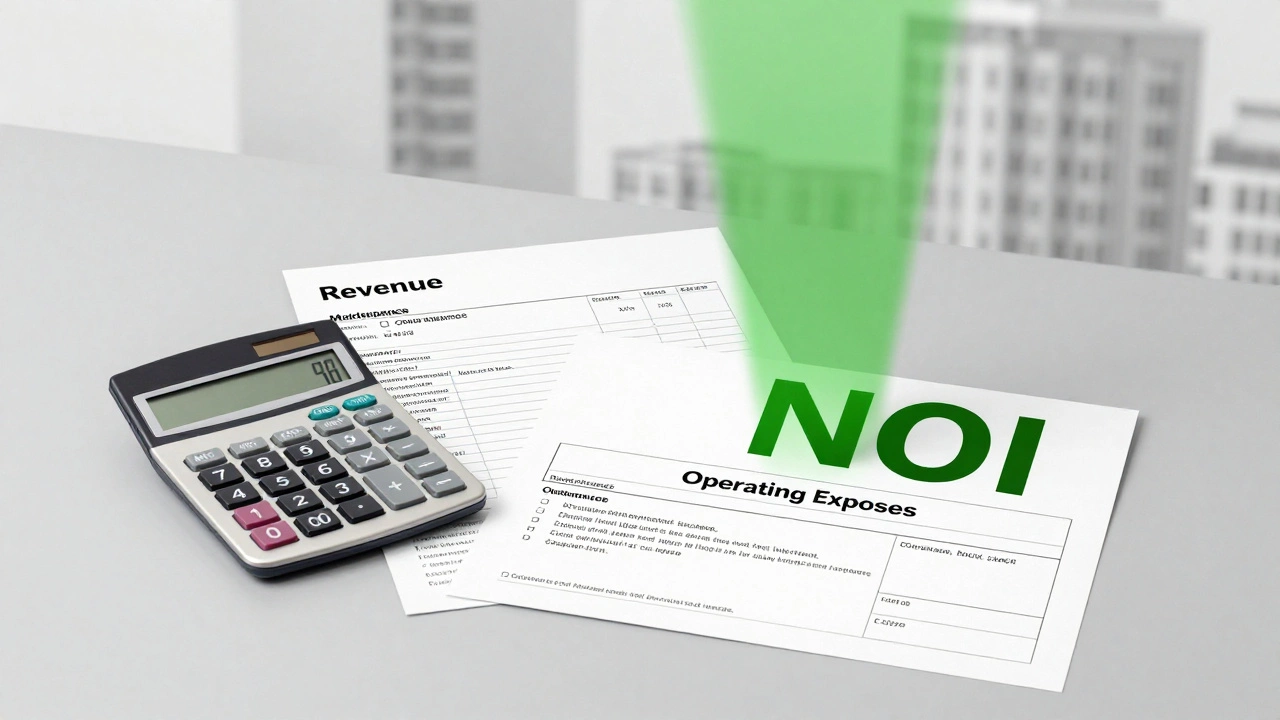
The Core Metric: Net Operating Income (NOI)
Before you can determine value, you need to know exactly how much profit your property makes each year. This number is called Net Operating Income, or NOI. Think of NOI as the pure earnings power of the building itself, stripped away from how you bought it or financed it.
To calculate NOI, you take all the revenue coming in from rents, parking fees, laundry machines, or vending contracts. Then, you subtract only the expenses required to keep the lights on and the doors open. These include property taxes, insurance, maintenance, repairs, and property management fees. Crucially, you do not subtract mortgage payments or income taxes. Why? Because the value of the building shouldn’t change just because one owner has a high-interest loan and another paid cash. The building’s performance is independent of the debt used to buy it.
- Gross Revenue: Total rent + other income sources.
- Operating Expenses: Taxes, insurance, maintenance, utilities (if owner-paid), management fees.
- NOI Formula: Gross Revenue - Operating Expenses = NOI.
If your building brings in $500,000 a year in rent and costs $150,000 to operate, your NOI is $350,000. This is the starting point for every valuation conversation.
Understanding the Capitalization Rate (Cap Rate)
Once you have your NOI, you need a multiplier to turn that annual income into a total property value. That multiplier is the Capitalization Rate, commonly known as the cap rate. The cap rate represents the expected rate of return an investor would get if they bought the property entirely with cash, with no mortgage involved.
Cap rates vary wildly depending on location, property type, and market conditions. A prime office building in a major city center might have a low cap rate of 4% to 5%, indicating lower risk and higher demand. A smaller retail store in a suburban area might trade at a 7% to 9% cap rate, reflecting higher risk. Industrial warehouses in logistics hubs often see cap rates between 5% and 6%.
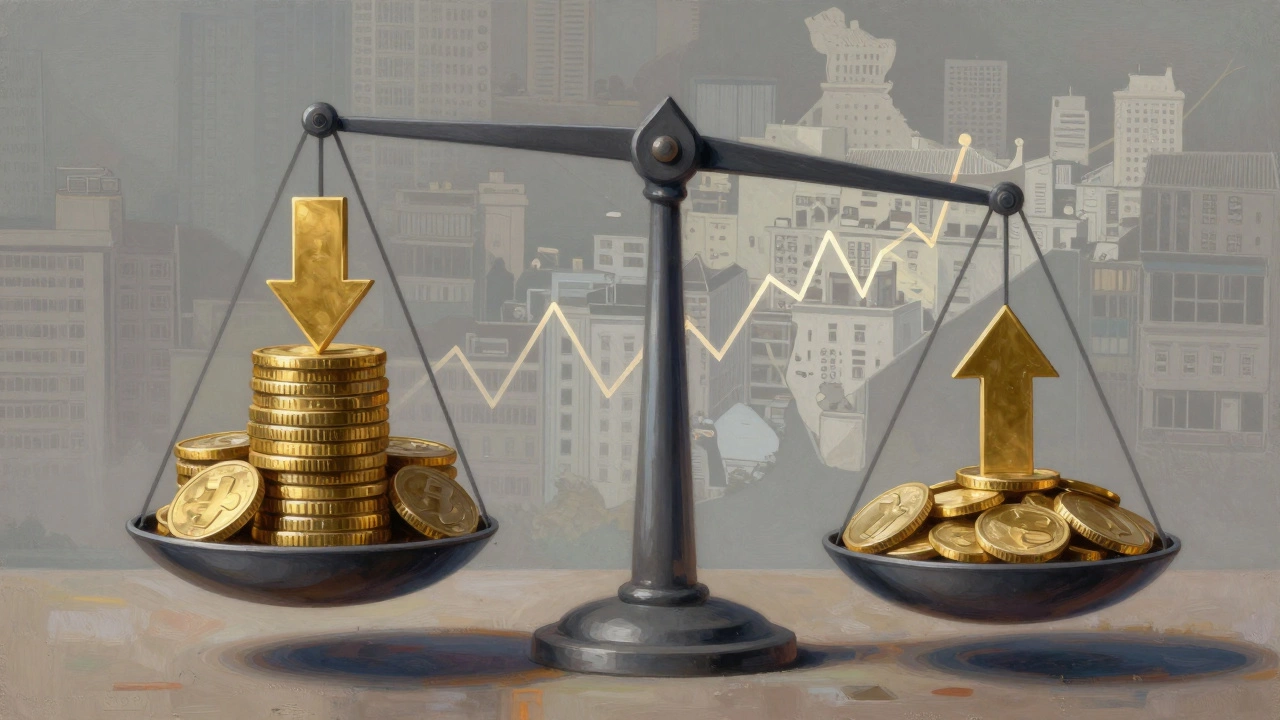
The relationship is inverse: as cap rates go down, property values go up. As cap rates rise, values drop. This happens because investors are chasing yield. When interest rates are low, people accept lower returns (lower cap rates) for safer assets, driving prices up. When rates rise or uncertainty hits, investors demand higher returns (higher cap rates), pushing prices down.
| Property Type | Low Risk / Prime Location | High Risk / Secondary Market |
|---|---|---|
| Office Buildings | 4.5% - 5.5% | 7.0% - 9.0% |
| Retail Centers | 5.0% - 6.0% | 8.0% - 10.0% |
| Industrial/Warehouse | 5.0% - 6.0% | 7.5% - 9.5% |
| Multifamily Apartments | 4.0% - 5.0% | 6.5% - 8.5% |
The Valuation Formula: How to Calculate Value
Now we put the pieces together. The most common method for valuing income-producing commercial real estate is the Direct Capitalization Approach. The formula is simple:
Property Value = Net Operating Income (NOI) ÷ Cap Rate
Let’s look at two scenarios to see how sensitive this math is.
Scenario A: You have a small office building with an NOI of $100,000. In a stable market, comparable sales suggest a cap rate of 6%. Your property value is $100,000 ÷ 0.06 = $1,666,666.
Scenario B: The same building, same NOI. But economic uncertainty rises, and investors now demand a 7% return for similar properties. Your new value is $100,000 ÷ 0.07 = $1,428,571.
Did your building change? No. Did your rent increase? No. But the market’s perception of risk shifted, causing your equity to drop by nearly $240,000 overnight. This volatility is why commercial owners must monitor cap rates closely. A tiny shift in the denominator creates a massive swing in the numerator.
Why Comparable Sales Matter More Than Guesses
You can’t just pick a cap rate out of thin air. To find the right rate, you need to look at recent sales of similar properties in your area. This is called the Market Approach. Brokers and appraisers analyze "comps"-properties that recently sold with similar size, age, tenant quality, and location.
If a similar building across town sold for $2 million with an NOI of $120,000, the implied cap rate was 6% ($120k / $2m). If your building has an NOI of $100,000, you might reasonably expect it to sell for around $1.66 million, assuming the market conditions are identical. However, you must adjust for differences. Is your roof newer? Are your tenants longer-term? Does your building have better parking? These factors can justify a slightly lower cap rate (higher value) for your specific asset.
Other Valuation Methods: Cost and Discounted Cash Flow
While the cap rate method is the standard for quick estimates, other approaches provide deeper insights, especially for unique properties or those undergoing renovation.
The Cost Approach calculates what it would cost to rebuild the structure today, minus depreciation, plus the land value. This is less useful for older buildings where the market value differs significantly from construction costs, but it’s critical for special-purpose properties like schools or churches that rarely sell.
Discounted Cash Flow (DCF) Analysis is used for more complex deals. Instead of looking at just one year of NOI, DCF projects income over 5, 10, or 20 years, accounting for rent increases, vacancies, and eventual resale value. It then discounts those future dollars back to today’s value using a required rate of return. This method is preferred by institutional investors and lenders for large transactions because it captures the nuance of growth and exit strategies.
Factors That Boost or Bust Your Property’s Value
Beyond the math, several qualitative factors influence what buyers will pay. Understanding these helps you maximize value before listing.
- Tenant Quality: A building leased to a Fortune 500 company with a 10-year lease is worth more than one with five small tenants signing month-to-month. Creditworthiness reduces risk.
- Occupancy Rates: Vacant space drags down NOI and signals potential issues. A 95% occupied building commands a premium over one at 80%.
- Location Trends: Is your neighborhood gentrifying? Are new transit lines being built? Proximity to amenities drives demand.
- Physical Condition: Deferred maintenance kills value. Updated HVAC systems, modern lobbies, and energy-efficient lighting reduce operating expenses, boosting NOI.
- Zoning Flexibility: Properties zoned for multiple uses (e.g., mixed-use residential/commercial) often sell for more due to their versatility.
Common Mistakes in Self-Valuation
Many owners fall into the trap of emotional attachment or outdated data. Here are three pitfalls to avoid:
- Ignoring Expense Growth: Property taxes and insurance premiums rise over time. If you base your NOI on last year’s numbers without adjusting for current costs, you’ll overvalue your asset.
- Using Residential Comparables: Your neighbor’s house sold for $1 million per square foot? Irrelevant. Commercial buyers care about yield, not prestige.
- Overlooking Hidden Liabilities: Environmental issues, pending lawsuits, or code violations can drastically reduce value. Disclose these early or address them before selling.
When to Hire a Professional Appraiser
You can estimate your property’s value yourself, but formal decisions require professional validation. Lenders require certified appraisals for loans exceeding certain thresholds. Courts need them for divorce settlements or estate planning. Even savvy investors hire appraisers to negotiate better purchase prices or refinance terms.
A licensed commercial appraiser doesn’t just plug numbers into a formula. They inspect the physical condition, verify lease terms, analyze local market trends, and apply rigorous standards set by organizations like the Appraisal Institute. Their report carries weight with banks and insurers, providing credibility that a spreadsheet cannot match.
How often should I reassess my commercial property's value?
You should review your property’s estimated value annually, especially when renewing leases or refinancing. However, a formal appraisal is typically needed every 3-5 years or whenever there is a significant change in the market, such as a major tenant leaving or a new competitor opening nearby.
Does a higher cap rate mean a better investment?
Not necessarily. A higher cap rate means a higher initial return, but it also usually indicates higher risk. Properties in declining neighborhoods or with unstable tenants may offer high cap rates but pose greater chances of vacancy or loss. Balance yield with stability.
Can I increase my property's value without raising rent?
Yes. By reducing operating expenses, you boost your Net Operating Income (NOI). Examples include installing energy-efficient lighting, negotiating lower insurance premiums, or self-managing instead of paying a third-party firm. Since value equals NOI divided by cap rate, any increase in NOI directly raises value.
What is the difference between Gross Rent Multiplier (GRM) and Cap Rate?
GRM is a simpler metric: Property Price divided by Gross Annual Rent. It ignores expenses, making it less accurate but faster for quick comparisons. Cap Rate uses Net Operating Income, providing a clearer picture of actual profitability after costs. Professionals prefer Cap Rate for serious valuations.
How do interest rates affect commercial property values?
Higher interest rates generally lead to higher cap rates, which lowers property values. When borrowing costs rise, investors demand higher yields to compensate for the increased cost of capital. Conversely, low interest rates tend to suppress cap rates and inflate property prices.