Virginia Land Price Calculator
Estimated Price
Land in Virginia doesn’t come with a single price tag. What you pay per acre depends on where you look, what the land is used for, and who’s selling. A wooded lot in the mountains might cost half what a buildable plot near Richmond demands. Farmland in the Shenandoah Valley? That’s another story entirely. If you’re thinking about buying land in Virginia, you need to know the real numbers - not guesses or outdated stats from 2020.
What’s the average price per acre in Virginia right now?
In 2026, the statewide average for undeveloped land sits around $12,500 per acre. But that number is misleading if you don’t break it down. The state isn’t one uniform market. It’s a patchwork of regions with wildly different values.
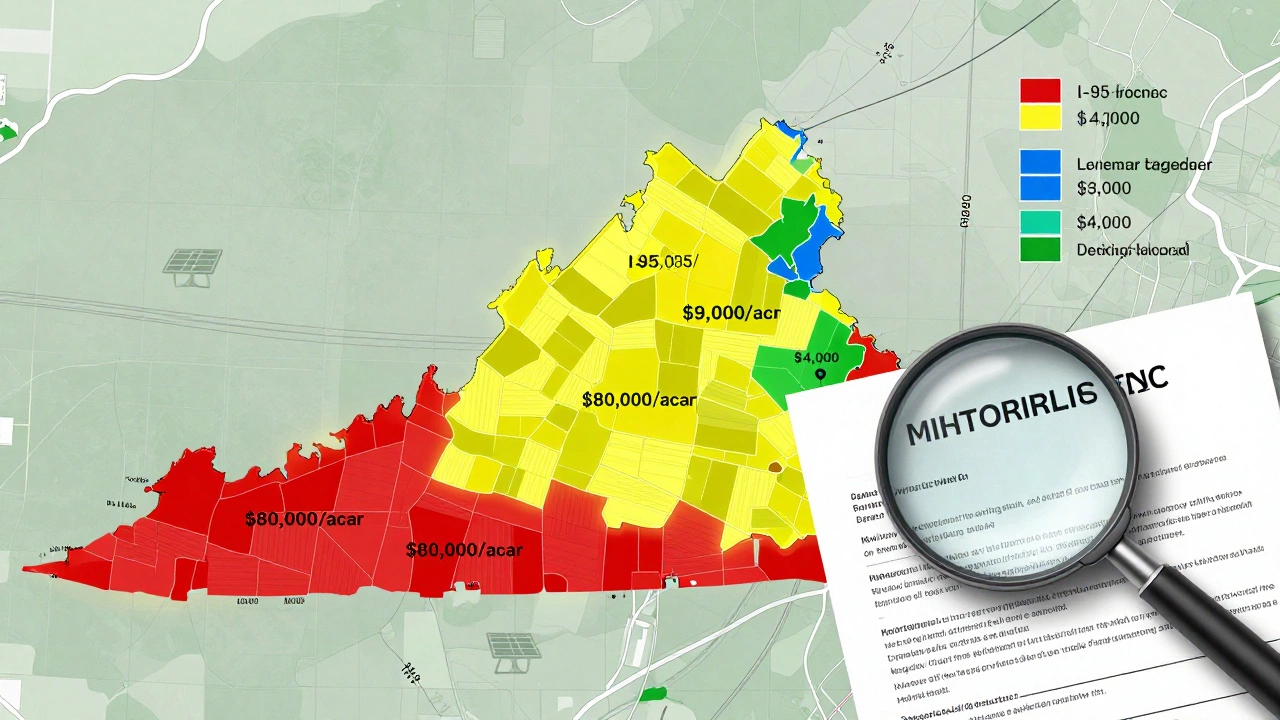
For example, in rural counties like Patrick or Dickenson, you can find land for as low as $3,000 to $5,000 per acre. These areas are remote, with limited access to utilities, and often used for hunting or timber. On the other end, near the I-95 corridor - places like Fredericksburg, Hanover, or Prince William County - prices jump to $40,000 to $80,000 per acre. Why? Because these are the suburbs expanding fast. Developers are snapping up land for housing projects, and residential demand is driving prices up.
Farmland vs. recreational land vs. buildable lots
Not all land is the same. Virginia’s land market splits into three main categories, each with its own pricing rules.
- Farmland: Average price: $6,000-$10,000 per acre. The best deals are in the Piedmont and Shenandoah Valley, where soil is rich and water access is reliable. Land that’s been farmed for decades often sells at a premium because it comes with established drainage, fencing, and sometimes even irrigation systems.
- Recreational land: Average price: $8,000-$18,000 per acre. Think wooded tracts with creeks, hunting rights, or mountain views. These are popular with retirees and outdoor enthusiasts. In counties like Craig or Giles, you’ll find 20-50 acre parcels listed for $150,000-$300,000 total - that’s $3,000-$6,000 per acre. But if that same land has a creek, a spring, and is within 20 miles of a town, prices climb fast.
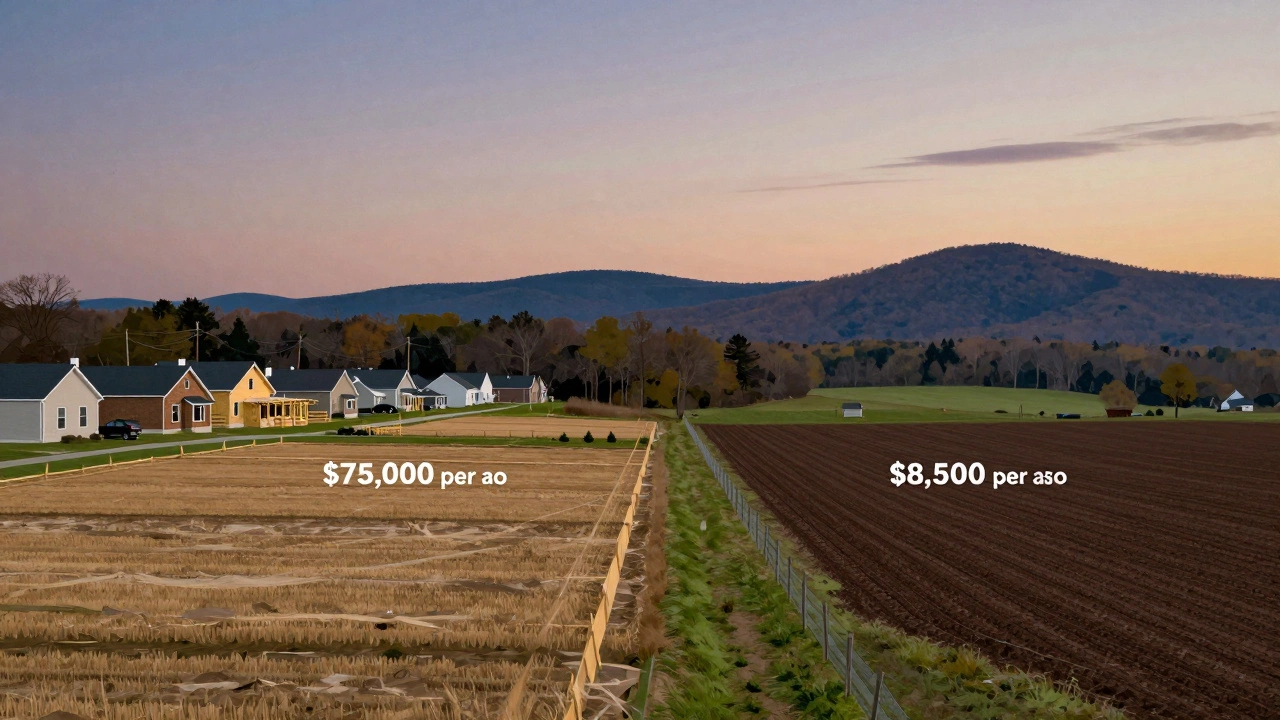
- Buildable lots: Average price: $25,000-$100,000 per acre. This is where the real money is. You’re not just buying dirt - you’re buying the right to build. To qualify as a buildable lot, the land must pass septic and well tests, have road access, and meet local zoning rules. In Chesterfield County, a 1-acre lot zoned for single-family homes can easily cost $75,000. In Loudoun County, near Dulles Airport, it’s not uncommon to see $120,000 per acre for land with pre-approved permits.
Why some areas cost 10x more than others
Location isn’t just about proximity to cities - it’s about infrastructure, growth trends, and future planning. Take Roanoke County versus Wythe County. Both are in western Virginia. Roanoke’s population is growing. New schools, hospitals, and highways are being built. Land prices there have jumped 32% in the last three years. Wythe County? Still rural. No major development plans. Land there? Stable at $4,500 per acre.
Another big factor: utility access. If the land doesn’t have water, sewer, or electricity nearby, you’re looking at $15,000-$50,000 in extra costs just to hook up. That’s why land priced at $8,000 per acre might end up costing you $30,000 after infrastructure. Always ask: “Can I build here without spending more than the land itself?”
How to find the right land for your budget
If you’re serious about buying, start with these steps:
- Decide what you want to use the land for. Are you building a home? Starting a farm? Using it for recreation? Your goal changes everything.
- Use the Virginia Department of Agriculture and Consumer Services (VDACS) land value reports. They publish annual data broken down by county. It’s free and updated for 2026.
- Check local tax assessor websites. Land value for tax purposes is often lower than market value, but it gives you a baseline. For example, in Buckingham County, the tax-assessed value per acre is $4,200 - but actual sales last year averaged $9,100.
- Work with a local land agent. They know which parcels are about to be rezoned, which have hidden easements, and which sellers are desperate. A good agent can find you a $15,000 acre that no one else is advertising.
- Don’t ignore zoning. Some land looks cheap - until you find out you can’t build a house, only a shed. Always verify permitted uses before making an offer.
What to watch out for
Land deals can look like bargains - until the surprises show up.
- Environmental restrictions: Wetlands, endangered species habitats, or flood zones can block development. In the Tidewater region, nearly 18% of listed land has some kind of environmental constraint.
- Mineral rights: In parts of southwestern Virginia, coal and natural gas rights are often owned by someone else. You might own the surface - but not what’s underneath. Always check the deed history.
- Access issues: If your land is only reachable by a dirt road owned by a neighbor, you could be stuck. Easements are common. Get them in writing.
- Property taxes: Virginia’s land tax rates vary. In Fairfax County, it’s 1.15% of assessed value. In Lee County, it’s 0.8%. That’s hundreds of dollars difference per year on a $100,000 parcel.
Where to find the best deals in 2026
Right now, the most promising areas for value are:
- Appalachian counties: Buchanan, Wise, and Lee. Land here is still under $7,000 per acre, and interest is rising as remote workers look for quiet retreats.
- Southside Virginia: Dinwiddie, Sussex, and Nottoway. Close to Richmond, but not yet overrun. Average price: $11,000-$14,000. Good for farming or future development.
- Eastern Shore: Accomack and Northampton counties. Beachfront land is expensive, but inland tracts - especially those with mature timber - are selling at $6,500-$9,000 per acre. Buyers are snapping them up for sustainable forestry projects.
One trend to note: solar farms. In 2025, over 200 new solar projects were approved across Virginia. Many are leasing land, not buying it. But that’s creating a ripple effect - landowners near proposed solar sites are seeing offers jump 40-60% just because of proximity. If you own land near a transmission line or highway, it might be worth more than you think.
Final tip: Don’t rush
Land doesn’t depreciate. It doesn’t need repairs. But it can tie up your money for years. Many buyers panic and buy the first plot they see. Then they realize they can’t build on it. Or the soil won’t support a septic system. Or the neighbors are planning a quarry.
Take your time. Visit the land in all seasons. Talk to locals. Ask about flooding after heavy rain. Check the county’s 10-year development plan. Look at satellite images from 2020 and 2025. Compare three different parcels before making a move.
Land in Virginia is a long-term investment. The right acre can be worth $50,000 in 10 years. The wrong one? It could sit empty for a decade. Know the numbers. Know the rules. And never assume.
What is the cheapest land per acre in Virginia?
The cheapest land in Virginia is typically found in rural southwestern counties like Dickenson, Buchanan, or Lee. Prices can dip as low as $3,000 per acre, especially for tracts over 20 acres with no road access, no utilities, and no building potential. These are often used for hunting, timber, or conservation. Be aware: low price doesn’t mean low cost. Installing a well, septic system, and driveway can add $20,000-$50,000 in upfront expenses.
Is land in Virginia a good investment in 2026?
Yes - if you’re patient and strategic. Virginia’s population is growing, especially in the I-95 corridor and around Richmond and Roanoke. Land near these areas is increasing in value by 5-8% per year. Farmland and recreational land in less developed regions are also seeing steady demand from remote workers and outdoor lifestyle buyers. However, land doesn’t generate income unless you use it. It’s not like renting a house. You’re betting on future appreciation, not immediate returns.
How do property taxes on land work in Virginia?
Virginia taxes land based on its assessed value, which is set by county assessors. Rates range from 0.8% to 1.3% of assessed value. For example, a $100,000 parcel in Fairfax County pays $1,150 per year in land tax. In Lee County, it’s $800. Agricultural land can qualify for a lower tax rate if it’s actively farmed. You must apply for this through your county’s commissioner of revenue. Don’t assume you’ll pay less just because it’s farmland - you need to prove active use.
Can I buy land in Virginia as a non-resident?
Yes, absolutely. There are no restrictions on out-of-state or foreign buyers purchasing land in Virginia. However, if you plan to build a home, you’ll need to hire a Virginia-licensed contractor and follow local building codes. You’ll also need to pay state income tax on any rental income. If you’re buying for investment, consider setting up an LLC to manage the property - it helps with liability and taxes.
What’s the difference between land value and market value in Virginia?
Land value is what the county says it’s worth for tax purposes - often lower than what buyers are actually paying. Market value is what someone is willing to pay today. For example, a parcel might be assessed at $6,000 per acre but sold for $14,000 because it has a spring, a road, and is near a planned highway expansion. Always rely on recent sales data, not tax assessments, when making an offer.