
Housing Affordability & Stress Calculator
Your Financial Details
Analysis Result
Recommended Max (30%)
Your Actual Cost
Imagine getting your paycheck and immediately handing over nearly half of it just to keep a roof over your head. You’re not broke, but you feel broke. This is the reality for millions of people navigating today’s property market. If you are asking yourself how much of your income should go to housing, you are likely trying to find that elusive line between living comfortably and drowning in debt.
The traditional advice says 30%. But does that number still work when rents in cities like Melbourne have skyrocketed and interest rates fluctuate? The short answer is: it depends on where you live and what else you need to buy. Let’s break down the math, the myths, and the real-world strategies for keeping your housing costs manageable without sacrificing your quality of life.
The Origin of the 30% Rule
You have probably heard the 30% rule is a guideline suggesting that no more than 30% of your gross monthly income should be spent on housing costs. This isn’t just a random guess; it has roots in US federal housing policy from the 1960s. Specifically, it comes from the Brooke Amendment of 1969, which capped housing assistance payments at 25% of a tenant’s adjusted income. Over time, this shifted into a general benchmark for affordability used by landlords, lenders, and financial planners worldwide.
The logic was simple: if you spend less than a third of your money on shelter, you have enough left for food, transport, healthcare, and savings. It provided a standardized way to determine who qualified for subsidized housing. However, applying this rigid historical standard to today’s dynamic economy can be misleading. Gross income (before tax) is very different from net income (what actually hits your bank account). In Australia, where taxes and Medicare levies take a significant chunk, using gross income as the baseline often leaves you with far less disposable cash than the rule implies.
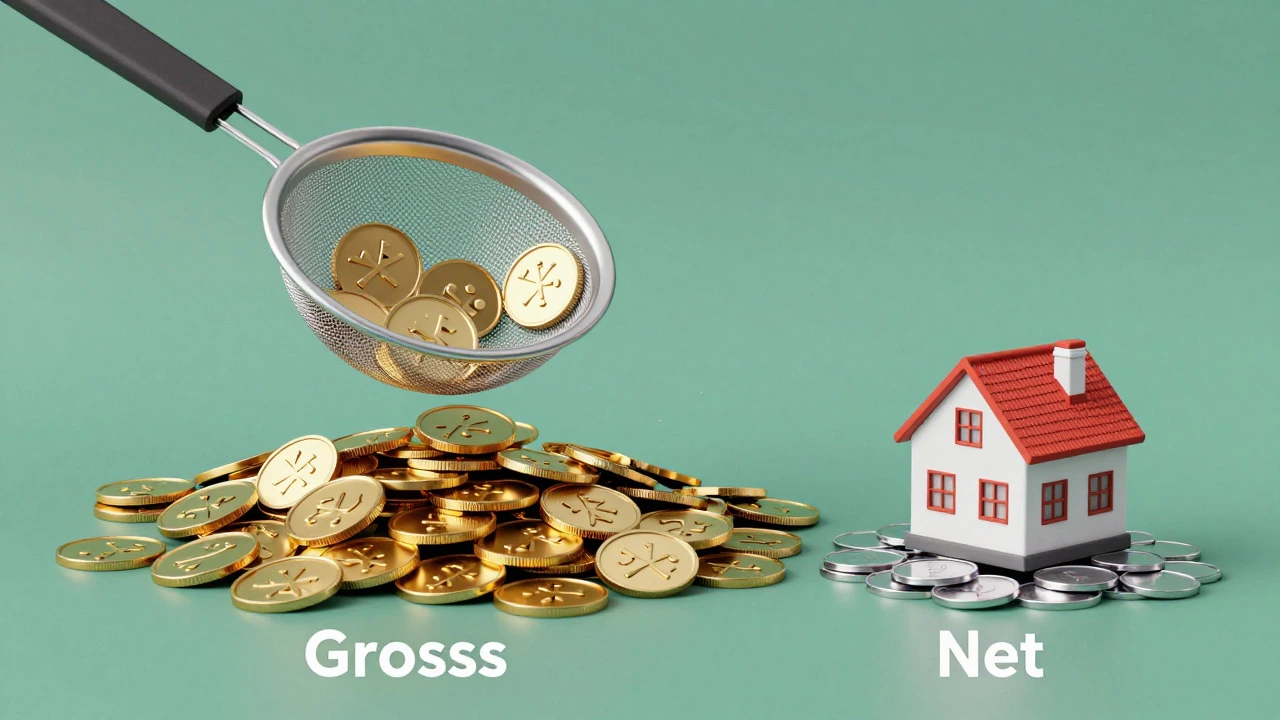
Gross vs. Net Income: The Critical Distinction
When calculating your housing budget, precision matters. Many people make the mistake of looking at their pre-tax salary. Let’s look at a concrete example. Say you earn $80,000 AUD per year. That’s roughly $6,666 per month before tax. Thirty percent of that is $2,000. Sounds manageable, right?
Now, let’s look at your take-home pay. After income tax and the Medicare levy, your net monthly income might be closer to $5,100. Thirty percent of your net income is only $1,530. That is a $470 difference every single month. If you budget based on gross income, you might sign a lease or take a mortgage that feels tight until you see your first payslip. For accurate planning, always use your after-tax, net income as the foundation for your calculations.
| Income Type | Annual Amount (AUD) | Monthly Amount (AUD) | 30% Threshold (AUD) |
|---|---|---|---|
| Gross Income | $80,000 | $6,666 | $2,000 |
| Net Income (Approx.) | $61,200 | $5,100 | $1,530 |
Is the 30% Rule Still Relevant in 2026?
In major metropolitan areas, sticking strictly to 30% of net income can be incredibly difficult. In cities like Sydney, Melbourne, or Brisbane, median rents often exceed what a single average earner can afford under this rule. According to recent data from the Australian Bureau of Statistics (ABS), many households are spending well over 30% of their disposable income on housing. This phenomenon is known as being "housing cost stressed."
If you are paying more than 30% of your net income on rent or mortgage repayments, you are technically in the stress zone. This doesn’t mean you are failing; it means the market is expensive. However, it does mean you have less buffer for emergencies. When unexpected costs arise-like a car repair or a medical bill-you have fewer resources to fall back on. The 30% rule serves as a warning light rather than a hard stop. If you are above it, you need to be extra diligent with other parts of your budget.
Factors That Shift Your Personal Housing Budget
Your ideal housing percentage isn’t one-size-fits-all. Several personal and geographic factors dictate whether 30% is safe or dangerous for your specific situation.
- Location: Living in a capital city center usually commands a premium. Suburban or regional areas may offer lower rents but could increase your transportation costs. Always factor in commute expenses. If you save $500 on rent but spend $200 extra on fuel and train tickets, your net savings are lower.
- Household Size: A single person has different needs than a family of four. While the total rent might be higher for a family, the per-person cost might be lower. Conversely, a single person renting a luxury apartment alone bears the full brunt of the price tag.
- Other Debts: Do you have student loans, credit card debt, or car payments? If your debt-to-income ratio is already high, your housing budget should shrink. Lenders often look at a total debt servicing ratio, ensuring that all debts combined don’t consume too much of your income.
- Lifestyle Goals: Are you saving for a house deposit, traveling extensively, or prioritizing dining out? High discretionary spending requires a lower housing cost to maintain balance.
Renters vs. Homeowners: Different Rules Apply
The calculation changes slightly depending on whether you are renting or owning. For renters, the cost is straightforward: rent plus any additional fees like water rates or strata levies if applicable. There are no hidden maintenance bills unless something breaks that isn’t covered by the landlord.
For homeowners, the picture is more complex. Your mortgage payment is just the tip of the iceberg. You must also account for council rates, land tax, building insurance, home insurance, and regular maintenance. A good rule of thumb for homeowners is to add about 10-15% to your mortgage payment to cover these ongoing costs. So, if your mortgage is $2,000, your true housing cost is closer to $2,300. Failing to include these can lead to severe budget strain later.

Strategies to Reduce Housing Cost Burden
If you find yourself exceeding the recommended thresholds, there are practical steps you can take to regain control. First, consider roommates. Sharing a larger property can drastically reduce individual costs. In Melbourne, sharing a three-bedroom unit can cut rent per person by nearly half compared to renting a studio alone.
Second, look at location trade-offs. Moving slightly further from the CBD or choosing a growing suburb rather than an established hotspot can yield significant savings. With remote work becoming more common, proximity to a central office is less critical for many professionals. This flexibility allows you to stretch your dollar further.
Third, review your entire budget. Sometimes, cutting small recurring expenses-like unused subscriptions or frequent takeout-can free up enough cash to handle a higher housing cost without feeling stressed. Every dollar saved elsewhere is a dollar that protects your housing stability.
What Happens If You Spend Too Much?
Spending too much on housing creates a ripple effect. It reduces your ability to save for retirement, invest, or handle emergencies. Financial experts often recommend having an emergency fund covering three to six months of expenses. If housing takes up 50% of your income, building this fund becomes twice as hard. You become vulnerable to job loss or economic downturns. Long-term, it can delay major life milestones like buying a home or starting a family. Recognizing the signs of housing stress early allows you to adjust before you reach a breaking point.
Is 30% of gross or net income the correct metric?
You should always use your net income (take-home pay) for personal budgeting. While lenders and some official statistics use gross income, your actual spending power is determined by what lands in your bank account after taxes. Using gross income can lead to overestimating your available budget.
What if I cannot afford housing within 30% of my income?
In high-cost cities, this is common. If you must spend more, aim to compensate by reducing other discretionary expenses. Look for ways to share costs, such as getting a roommate, or moving to a more affordable area. Prioritize building an emergency fund to offset the reduced financial flexibility.
Does the 30% rule include utilities and internet?
Ideally, yes. Your housing budget should encompass all costs required to maintain your shelter. This includes electricity, gas, water, internet, and council rates. Excluding these can create a false sense of affordability. Aim to keep the total package under 30% of your net income.
How do lenders calculate affordability?
Lenders typically use a serviceability assessment that looks at your gross income against all debts, including the proposed mortgage. They often apply a stress test, assuming interest rates are higher than current levels, to ensure you can still repay the loan if conditions worsen. Their threshold may differ from your personal comfort level.
Can I spend more than 30% if I have a high income?
Yes. The 30% rule is a guideline for affordability, not a limit on lifestyle. If you have a high income and still meet your savings goals, debt obligations, and emergency fund requirements, spending 40% or 50% on a premium home is financially viable. The key is ensuring the rest of your finances remain healthy.