
Real Estate Profitability & Leverage Calculator
Profitability Analysis
Cost Breakdown
- Selling Price: $0
- Total Transaction Fees (Est.): -$0
- Maintenance Reserve (1%/yr): -$0
- Principal Paid Down: +$0
Buying a house feels like the ultimate adult milestone. You sign the papers, get the keys, and suddenly you’re an owner. But strip away the emotional high of moving into your first place, and you’re left with a cold, hard financial question: is it actually profitable? In 2026, with interest rates stabilizing but still higher than the historic lows of the previous decade, and digital platforms making it easier to buy property online, the answer isn’t a simple yes or no. It depends entirely on how long you plan to hold the asset and where you buy.
Many people assume that because house prices generally go up over time, buying is always a winning bet. That’s a dangerous assumption. Real estate is illiquid, expensive to maintain, and subject to local market swings. To figure out if buying a house makes sense for your wallet, we need to look at the actual mechanics of profit: appreciation, cash flow, tax benefits, and the hidden costs that eat into your returns.
The Two Engines of Profit: Appreciation and Cash Flow
When investors talk about making money from real estate, they are usually talking about two specific things. Understanding the difference between these two is crucial because they work on completely different timelines.
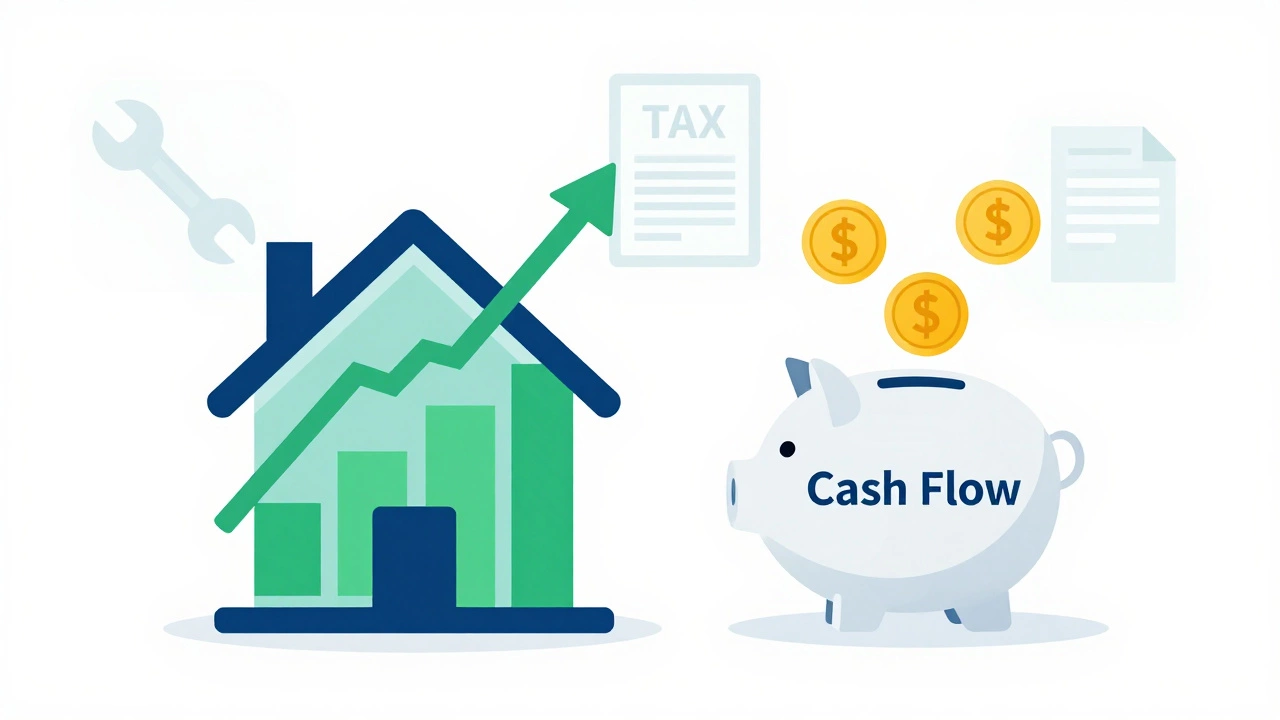
Appreciation is the increase in the value of the property itself. If you buy a house for $300,000 today and sell it for $450,000 ten years later, you’ve made $150,000 in equity growth. This is passive wealth building. You don’t have to do anything except own the home and hope the neighborhood improves. However, appreciation is not guaranteed. Markets cycle. Between 2022 and 2024, many markets saw stagnation or even declines as central banks raised rates to fight inflation. By 2026, while prices have stabilized, the era of double-digit annual gains is largely behind us. You are now looking for steady, moderate growth rather than explosive spikes.
Cash flow, on the other hand, is the money left over after you pay all expenses. If you rent out the property, cash flow is what hits your bank account each month. For most primary residences, there is no cash flow-you are paying more into the mortgage than you would pay in rent (usually). But if you are buying an investment property, positive cash flow is the safety net. It means the asset is paying for itself. In 2026, finding properties with strong positive cash flow requires careful selection. High-interest environments mean your monthly debt service is higher, which squeezes margins. You need to look for areas with strong rental demand but lower entry prices, often found in emerging suburbs or secondary cities rather than prime urban centers.
| Metric | Primary Residence | Investment Property |
|---|---|---|
| Main Goal | Housing stability & forced savings | Income generation & capital gains |
| Tax Benefits | Mortgage interest deduction (limited) | Depreciation, repairs, management fees |
| Liquidity | Low (hard to sell quickly) | Low (but can refinance for cash) |
| Risk Level | Medium (market dependent) | High (vacancy risk, tenant issues) |
| Effort Required | Minimal (maintenance only) | High (unless using a property manager) |
The Hidden Costs That Kill Profits
Here is where most beginners lose money. They look at the purchase price and the potential sale price, but they ignore the friction costs. Real estate is heavy. Every transaction involves significant fees. If you buy a house and sell it five years later, those fees can wipe out 10-15% of your total equity gain.
Consider this list of unavoidable expenses:
- Transaction Costs: When you buy, you pay closing costs, title insurance, and possibly agent commissions (depending on local laws). When you sell, you pay another round of commissions and transfer taxes. In many markets, this totals around 6-8% of the home’s value just to enter and exit the deal.
- Maintenance Reserve: A roof doesn’t last forever. HVAC systems fail. Paint fades. The rule of thumb is to set aside 1% of the property’s value annually for maintenance. On a $400,000 home, that’s $4,000 a year-$400 a month-that never comes back to you.
- Property Taxes and Insurance: These are non-negotiable annual bills. In some jurisdictions, property taxes can rise significantly if the assessed value of the home goes up, creating a "tax shock" that reduces your net income.
- Vacancy Risk: If you’re renting, there will be times when the unit is empty. You still owe the mortgage, taxes, and insurance. A conservative investor plans for one month of vacancy per year.
If you buy a house expecting it to appreciate by 5% a year, but you factor in 1% for maintenance, 0.5% for taxes/insurance increases, and transaction costs amortized over five years, your real return might be closer to 2-3%. Is that better than the stock market? Historically, the S&P 500 has returned about 7-10% annually before inflation. Real estate often wins on leverage (using borrowed money), but loses on liquidity and effort.
The Power of Leverage: Borrowing to Boost Returns
This is the secret sauce of real estate investing. Unlike stocks, where you typically put down 100% of the cash, you can buy a house with just 20% down. This is called leverage. Let’s say you have $100,000 to invest.
If you put that $100,000 into the stock market and it goes up 5%, you make $5,000. Your return on invested capital (ROIC) is 5%.
If you use that $100,000 as a down payment on a $500,000 house, and the house appreciates by 5%, the house value goes up by $25,000. But you only put in $100,000 of your own money. So your ROIC is 25% ($25,000 / $100,000). That’s huge.
However, leverage cuts both ways. If the house value drops by 5%, you lose $25,000 of equity. Your ROIC is -25%. Worse yet, you still have to pay the mortgage on the full $400,000 loan. If interest rates are high, the interest payments alone can exceed any appreciation, turning a leveraged position into a money loser. In 2026, with mortgage rates hovering around 6-7%, the cost of borrowing is significant. You need appreciation to outpace the interest rate plus holding costs to see a true gain. This makes leverage a powerful tool, but also a risky one if the market stalls.
Buying Online: Efficiency vs. Due Diligence
The way we buy homes has changed. Platforms allowing you to buy property online have streamlined the process. You can view virtual tours, apply for pre-approval digitally, and even close escrow remotely. This efficiency is great, but it introduces a new risk: skipping due diligence.
When you buy online, it’s tempting to rely solely on photos and data. But a photo can’t show you the smell of mold, the noise from the highway, or the cracks in the foundation. Profitability hinges on condition. A house that looks great online but needs a new roof is a profit killer. Always insist on a physical inspection, regardless of how convenient the online platform is. Use technology to find deals, not to replace your eyes.

When Buying a House Is NOT Profitable
It’s important to know when to stay away. Buying a house is likely a bad financial move if:
- You plan to move in less than 5-7 years. Transaction costs are so high that you need several years of appreciation just to break even. If you sell early, you’ll likely lose money after fees.
- You’re stretching your budget too thin. If your monthly payment consumes more than 30% of your gross income, you’re vulnerable. Any job loss or emergency repair will force you to sell at a bad time or drain your savings.
- The local market is oversaturated. Look at inventory levels. If months of supply are above 6 months, prices are likely to drop or stagnate. Don’t buy in a buyer’s market unless you’re getting a deep discount.
- You’re ignoring opportunity cost. Ask yourself: could I make more money with this same capital elsewhere? If you can earn 8% risk-free in bonds or index funds with zero hassle, and real estate offers 5% after all costs and headaches, the math favors the alternative.
How to Maximize Profitability in 2026
If you decide to buy, here is how to tilt the odds in your favor:
- Buy in Growth Corridors: Look for neighborhoods where infrastructure is being built. New transit lines, schools, or commercial centers drive appreciation. Don’t buy where the growth already happened; buy where it’s heading.
- Force Equity Through Principal Paydown: Even if the market doesn’t appreciate, every mortgage payment builds equity. Over 30 years, you own the house outright. That’s a guaranteed return of your principal, albeit with inflation erosion.
- Add Value: Cosmetic improvements like painting, landscaping, and updating fixtures can increase resale value without major structural work. This is active appreciation-you create the profit.
- Lock in Long-Term Rates: If you can secure a fixed-rate mortgage below the average return on assets, you’re effectively printing money as the asset appreciates. Shop around aggressively for the best rate.
Ultimately, buying a house is profitable if you treat it as a long-term wealth-building tool, not a short-term gamble. It provides stability, leverage, and tax advantages that few other investments offer. But it demands patience, discipline, and a clear understanding of the hidden costs. Do the math before you fall in love with the house.
How long should I own a house to make it profitable?
Financial experts generally recommend holding a property for at least 5 to 7 years. This timeframe allows you to amortize the initial transaction costs (closing costs, agent fees) and gives the market enough time to recover from any short-term dips. Selling earlier often results in breaking even or losing money after fees.
Is it better to buy a house or invest in the stock market?
It depends on your goals. The stock market offers higher historical returns (7-10% annually) with greater liquidity and less effort. Real estate offers leverage (using debt to amplify gains), tax benefits, and tangible utility (a place to live). If you want passive, hands-off growth, stocks may be better. If you want control, leverage, and housing stability, real estate wins.
What is a good rental yield for profitability?
A gross rental yield of 5-8% is considered healthy in most markets. Net yield (after expenses) should ideally be above 4% to cover risks and provide a buffer against vacancies and maintenance. If your net yield is below 3%, you are relying almost entirely on appreciation, which is riskier.
Can I buy a house profitably with a high interest rate?
Yes, but the math changes. Higher interest rates reduce purchasing power and increase monthly costs. To remain profitable, you need to ensure that the property’s appreciation or rental income outpaces the interest cost. Look for properties priced below market value or in areas with strong growth fundamentals to offset the higher borrowing cost.
Does buying a house build wealth faster than renting?
Only if you invest the difference. Renters save money upfront and have lower monthly obligations. If renters take that saved cash and invest it in diversified assets, they can sometimes outperform homeowners who are tied up in illiquid equity. Homeowners build wealth through forced savings (mortgage principal) and leverage, but only if they hold the asset long-term.