Commercial Real Estate Investment Analyzer
Property Details
Investment Analysis
Buying a building is not like buying a house. In residential real estate, you might look at curb appeal or the size of the backyard. In commercial real estate, a sector focused on properties used for business purposes rather than living quarters, the decision comes down to one thing: does the math work? If the numbers don't add up, the best location in the world won't save you from a bad investment. This is why investors obsess over rules of thumb. The most famous one is the "1% Rule." But here is the hard truth: in today's market, especially in major cities, the strict 1% rule is often impossible to meet. So, what do you do? You adapt.
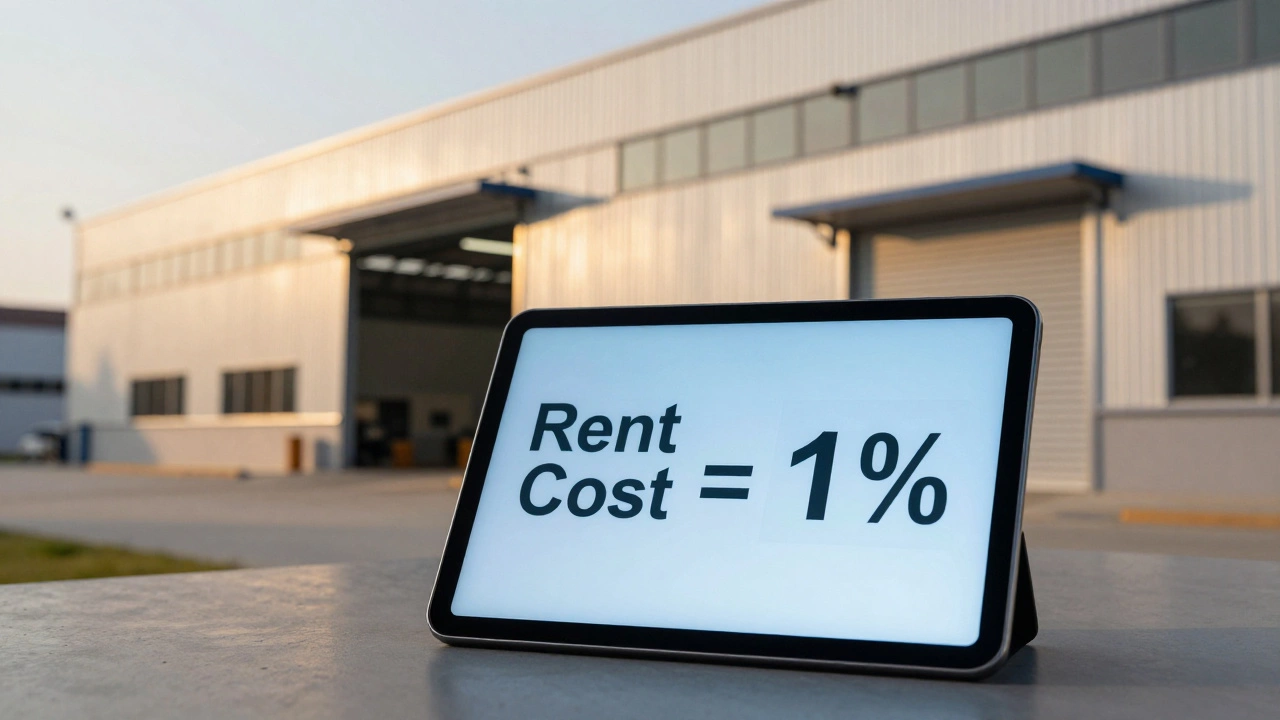
The concept is simple. You want the monthly gross rent to be at least 1% of the total acquisition cost. If you buy a warehouse for $500,000, you need $5,000 a month in rent just to pass the test. It sounds easy. It’s a quick filter to weed out bad deals before you spend hours analyzing spreadsheets. However, relying on it blindly can lead you to miss out on solid opportunities in high-cost markets. Let’s break down how this rule actually works, where it fails, and what modern investors use instead.
Understanding the Mechanics of the 1% Rule
To understand the rule, you have to strip away the complexity. The formula is brutally simple:
- Total Acquisition Cost: This includes the purchase price plus any immediate closing costs or renovation expenses needed to get the tenant signed.
- Gross Monthly Rent: The total amount all tenants pay each month, before you deduct anything for management, taxes, or repairs.
If the Gross Monthly Rent divided by the Total Acquisition Cost equals 1% or more, the deal passes the initial screen. Why does this matter? Because it ensures that your revenue is substantial enough to cover the inevitable costs of ownership. If you are paying 1% of the value in rent, you likely have enough buffer to pay your mortgage, insurance, and still pocket some profit. It acts as a safety net against unexpected vacancies or emergency roof repairs.
However, there is a catch. The 1% rule was born in an era of lower interest rates and cheaper land. Today, property prices in desirable areas have skyrocketed, but rents haven't kept pace at the same exponential rate. As a result, finding a deal that hits exactly 1% in a city center is nearly impossible. If you stick rigidly to this rule, you will only find distressed properties in declining neighborhoods, which brings its own set of risks.
Why the Strict 1% Rule Fails in Modern Markets
Let’s look at a realistic scenario. Imagine you are looking at a small office building in a growing suburb. The asking price is $1 million. To hit the 1% rule, you need $10,000 in monthly rent. That means your annual gross income needs to be $120,000. On a $1 million asset, that is a 12% gross yield. In many mature markets, a 6% to 8% gross yield is considered excellent. Expecting 12% is setting yourself up for failure.
This discrepancy happens because the 1% rule ignores the power of leverage. When you use a mortgage, you aren't putting down the full $1 million. You might put down 25%, or $250,000. Now, let's apply the rent to your actual cash invested. If that $10,000 monthly rent covers the mortgage payment and leaves you with $2,000 in cash flow, your return on equity (ROE) is much higher than the raw 1% suggests. The rule doesn't account for debt service, appreciation potential, or tax benefits like depreciation.
Furthermore, different asset classes behave differently. A self-storage facility might command higher rents per square foot than a retail strip mall. A medical office building with long-term triple-net leases offers stability that a short-term retail lease cannot match. Applying a blanket 1% rule across these diverse sectors is like using a single ruler to measure both height and weight-it just doesn't fit.
| Metric | Definition | Typical Target Range |
|---|---|---|
| 1% Rule | Gross monthly rent / Purchase price | 1.0% - 1.5% |
| Cash-on-Cash Return | Annual pre-tax cash flow / Total cash invested | 6% - 10%+ |
| Cap Rate | Net Operating Income / Current Market Value | 4% - 8% |
| Gross Yield | Gross Annual Rent / Purchase Price | 6% - 12% |

Better Alternatives: Cap Rates and Cash-on-Cash Returns
Since the 1% rule is often too rigid, savvy investors use metrics that provide a clearer picture of profitability. The two most important ones are the Capitalization Rate (Cap Rate) and Cash-on-Cash Return.
The Cap Rate is a rate of return on a real estate investment property based on the income that the property is expected to generate. It is calculated by dividing the Net Operating Income (NOI) by the property's current market value. NOI is the revenue left after operating expenses (like maintenance and taxes) but before mortgage payments. A higher cap rate generally indicates a higher risk but also a higher potential reward. In stable markets, a 5% to 7% cap rate is common for commercial assets. This metric helps you compare apples to apples across different properties, regardless of how they are financed.
On the other hand, Cash-on-Cash Return focuses on your personal wallet. It measures the annual return on the actual cash you invested. If you invest $200,000 in down payment and closing costs, and the property generates $15,000 in positive cash flow after all expenses and mortgage payments, your cash-on-cash return is 7.5%. This is often more relevant for active investors who need regular income, as it reflects the true efficiency of your capital deployment.
Using these metrics together gives you a balanced view. The cap rate tells you about the property's inherent value and risk, while the cash-on-cash return tells you how well the financing structure works for you. Don't rely on just one number. Look at the combination.
Hidden Costs That Kill Cash Flow
Even if your numbers look good on paper, hidden costs can destroy your returns. Many beginners forget to account for vacancy rates. No building is occupied 100% of the time. Between tenants moving out and new ones moving in, you lose income. A safe bet is to assume a 5% to 10% vacancy rate when calculating your projected income. If you budget for full occupancy and then face a three-month gap, your cash flow turns negative.
Then there are capital expenditures (CapEx). Roofs don't last forever. HVAC systems fail. Parking lots crack. You need to set aside money for these large, infrequent repairs. A common rule of thumb is to reserve 5% to 10% of your gross income annually for CapEx reserves. If you don't, you'll be scrambling for cash when the elevator breaks down.
Property management fees are another silent killer. If you hire a manager, expect to pay 5% to 10% of the collected rent. While managing the property yourself saves money, it costs time. Time is money, especially if you have a day job. Factor in the opportunity cost of your own labor if you choose to self-manage.

Location and Tenant Quality Matter More Than Rules
No mathematical rule can compensate for a bad location or a weak tenant. In commercial real estate, the tenant is the product. A building leased to a credit-worthy national chain with a 10-year lease is worth more than an identical building with five small, risky tenants on year-to-year contracts. The former provides predictable income and easier refinancing. The latter requires constant marketing and carries higher default risk.
When evaluating a deal, look at the tenant mix. Are they complementary? Do they drive foot traffic to each other? In a retail center, having a grocery anchor store can support smaller specialty shops. In an office park, having multiple professional services firms creates a cluster effect that attracts more clients. These qualitative factors often outweigh minor differences in the 1% calculation.
Additionally, consider the macroeconomic trends. Is the neighborhood improving or declining? Are new highways being built that will increase accessibility? Or are zoning laws changing that could limit future development? These external forces impact long-term value appreciation, which is a significant part of your total return. The 1% rule only looks at current cash flow, ignoring the potential for the asset to grow in value over time.
Investing in real estate requires patience and diligence. It is not a get-rich-quick scheme. It is a wealth-building strategy that rewards those who do their homework. Use the 1% rule as a starting point, a quick sanity check. But don't let it blind you to good deals that require deeper analysis. Combine it with cap rates, cash-on-cash returns, and a thorough understanding of the local market. That is how you build a portfolio that withstands economic cycles.
For those exploring international markets or unique property types, diversification can be key. Some investors look beyond domestic borders to find higher yields in emerging economies. For example, some explore directories like this resource to understand niche service economies in regions like Central Asia, though such ventures carry distinct regulatory and cultural risks that differ vastly from traditional brick-and-mortar investments. Always ensure your investment strategy aligns with your risk tolerance and legal compliance standards.
Practical Steps to Analyze Your Next Deal
Here is a checklist to use before making an offer:
- Verify the Income: Ask for the rent roll and verify it with bank statements. Don't trust the seller's projection alone.
- Estimate Expenses: Get quotes for insurance, taxes, and maintenance. Add a 10% buffer for surprises.
- Calculate NOI: Subtract expenses from gross income. This is your baseline for valuation.
- Determine Cap Rate: Divide NOI by the asking price. Compare this to similar recent sales in the area.
- Model Financing: Run scenarios with different interest rates and down payments. See how sensitive your cash flow is to rate changes.
- Assess Physical Condition: Hire a qualified inspector. Identify any immediate CapEx needs and subtract them from your offer price.
- Evaluate Exit Strategy: How will you sell this in 5 to 10 years? Who is the buyer? Ensure the asset has broad appeal.
By following these steps, you move beyond simplistic rules and into strategic investing. You start seeing properties not just as buildings, but as businesses that generate cash flow. This shift in mindset is what separates amateur speculators from professional investors. Remember, the goal is not just to buy property, but to acquire assets that enhance your financial freedom. Do the work, ask the hard questions, and never stop learning.
Is the 1% rule still relevant in 2026?
The 1% rule is less relevant in high-cost urban markets due to rising property values. It remains useful as a quick screening tool for suburban or rural properties, but investors should prioritize Cap Rates and Cash-on-Cash returns for accurate analysis.
What is a good Cap Rate for commercial real estate?
A good Cap Rate varies by asset class and location. Generally, 4% to 6% is typical for Class A office buildings in prime cities, while 7% to 9% or higher might be seen for industrial or retail properties in secondary markets. Higher Cap Rates indicate higher risk.
How do I calculate Cash-on-Cash Return?
Divide your annual pre-tax cash flow by the total amount of cash you invested (down payment + closing costs + renovations). For example, $10,000 annual cash flow on a $100,000 investment equals a 10% Cash-on-Cash return.
Should I focus on gross rent or net income?
Always focus on Net Operating Income (NOI). Gross rent ignores expenses like taxes, insurance, maintenance, and vacancy. NOI provides a realistic view of the property's profitability before financing costs.
What are the biggest risks in commercial real estate?
Key risks include tenant default, rising interest rates, physical deterioration of the asset, and changes in local zoning or economic conditions. Diversification and thorough due diligence help mitigate these risks.