
You are looking at a promising office building or a strip mall. The listing shows the price and the annual rent. You need to know if it’s a good deal. This is where GRM comes in. It stands for Gross Rent Multiplier. It is one of the simplest ways to value commercial property. Investors use it to compare deals quickly. It tells you how many years it will take for the rent to pay back your purchase price.
If you ignore this metric, you might overpay. If you master it, you can spot undervalued assets. Let’s break down what GRM actually means, how to calculate it, and why it matters for your next investment.
The Core Concept of Gross Rent Multiplier
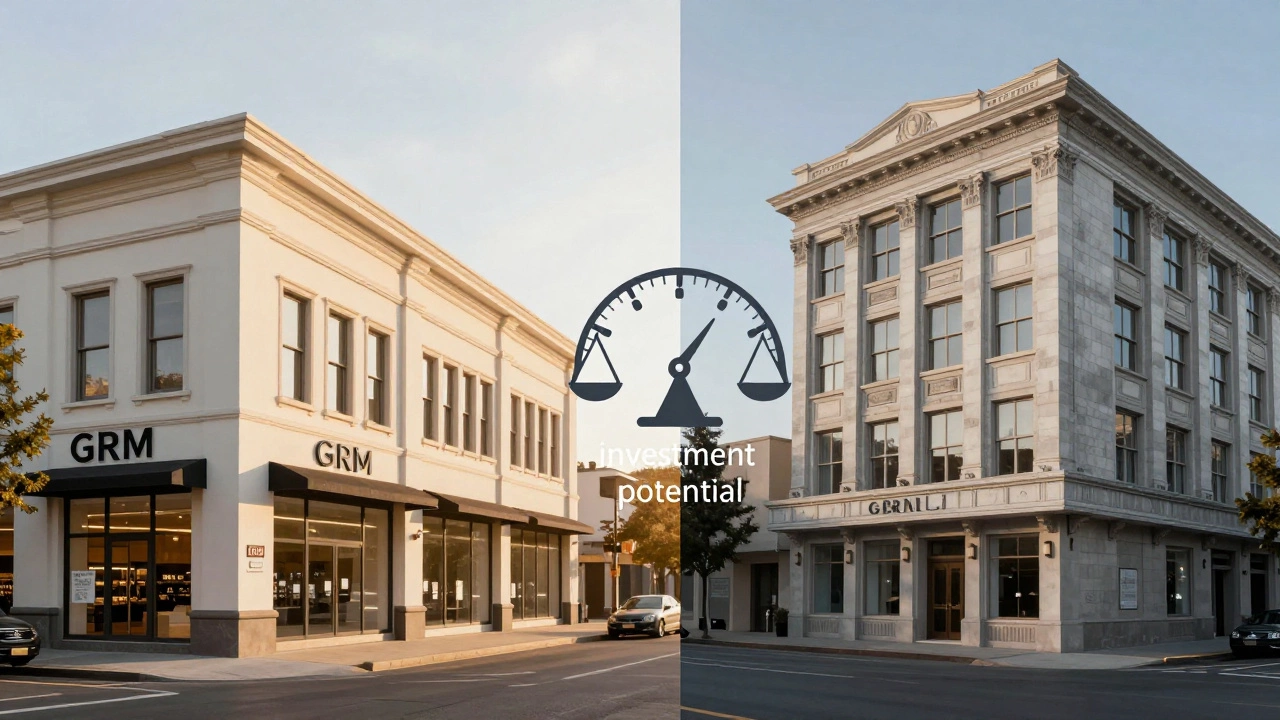
Gross Rent Multiplier (GRM) is a quick valuation ratio used in real estate to estimate the value of an income-producing property. It relates the property's price to its gross rental income. Think of it as a speedometer for investment potential. A lower number usually means a better deal. A higher number suggests you are paying more for each dollar of rent.
This metric strips away complexity. It does not care about operating expenses like taxes, insurance, or maintenance. It only looks at two numbers: the sale price and the total rent collected before any costs. This makes it incredibly fast to use. You can calculate it on the back of a napkin during a site visit.
However, simplicity has limits. Because it ignores expenses, two buildings with the same GRM can have very different profits. One might have low maintenance costs. The other might be falling apart and needing constant repairs. You must understand this trade-off. GRM is a screening tool, not a final verdict.
How to Calculate GRM Step-by-Step
The formula is straightforward. You divide the property's market price by its Gross Scheduled Income (GSI). GSI is the total potential rent if every unit is occupied. Here is the math:
- Find the Purchase Price: Look at the asking price or the final sale price of the property.
- Determine Gross Annual Rent: Add up all the monthly rents from all tenants. Multiply by 12. Do not subtract vacancy losses yet. Use the theoretical maximum income.
- Divide Price by Rent: Take the price and divide it by the annual gross rent.
Let’s look at a concrete example. Imagine a small retail building for sale at $1,000,000. It has three storefronts. Each pays $5,000 per month. The total monthly rent is $15,000. The annual gross rent is $180,000 ($15,000 x 12).
Now, do the division: $1,000,000 / $180,000 = 5.55. The GRM is 5.55. This means the property costs 5.55 times its annual rent. In theory, it would take 5.55 years of gross rent to equal the purchase price.
Compare this to another building. Building B costs $1,200,000. Its annual gross rent is $150,000. The GRM is $1,200,000 / $150,000 = 8.0. Building A has a lower GRM. Based solely on this metric, Building A appears to be the cheaper option relative to its income.
Interpreting Your GRM Score
So, what is a "good" GRM? There is no universal magic number. It depends entirely on the location and the property type. Markets vary wildly. A GRM of 4 might be normal in a high-growth city center. The same score could be impossible in a rural area.
| Property Type | Low GRM (High Value) | High GRM (Lower Value) | Context Note |
|---|---|---|---|
| Multi-Family Residential | 4 - 6 | 10 - 12+ | Stable cash flow, lower risk |
| Retail Strip Malls | 6 - 8 | 12 - 15+ | Higher risk due to e-commerce |
| Office Buildings | 7 - 9 | 13 - 16+ | Vacancy rates impact actual income |
| Industrial Warehouses | 8 - 10 | 14 - 18+ | Long-term leases provide stability |
Generally, a lower GRM indicates a higher return on investment. If you see a GRM below 5, pause. Check for hidden problems. Is the roof leaking? Are the tenants non-paying? Sometimes a low GRM signals distress, not opportunity.
Conversely, a high GRM above 10 often means the property is expensive relative to its income. This might happen in premium locations where land value is high, even if current rents are modest. Or it could mean the seller is overpricing the asset. Always compare the GRM against recent sales of similar properties in the same neighborhood.
GRM vs. Cap Rate: Knowing the Difference
New investors often confuse GRM with the Capitalization Rate (Cap Rate). They are related but distinct. The Cap Rate considers net operating income (NOI), which subtracts expenses. GRM uses gross income. Here is how they connect:
Cap Rate = 12 / GRM (approximately, if using annual figures)
Let’s use our previous example. Building A had a GRM of 5.55. To find the approximate Cap Rate, divide 12 by 5.55. The result is roughly 2.16%. Wait, that seems low. Let’s re-check the math logic. Actually, the relationship is: Cap Rate ≈ 1 / GRM if GRM is based on annual rent. So 1 / 5.55 = 0.18 or 18%. That is a very high cap rate. Let’s stick to the direct definition to avoid confusion.
The key difference is depth. Cap Rate requires you to know all the expenses: property taxes, insurance, management fees, repairs, and vacancies. GRM skips all that. If you are doing a quick screen of 50 listings, use GRM. If you are writing a check for one specific building, switch to Cap Rate. GRM gets you in the door. Cap Rate closes the deal.

Pitfalls to Avoid When Using GRM
Using GRM blindly can lead to costly mistakes. Here are the most common traps:
- Igoring Vacancy: GRM assumes 100% occupancy. If the building has been empty for six months, the gross rent is theoretical, not real. Adjust your expectations accordingly.
- Mixing Property Types: Comparing the GRM of a luxury condo to a rundown warehouse is useless. Only compare apples to apples. Use local comps (comparable sales) to set benchmarks.
- Ignoring Expense Variance: Two buildings can have identical GRMs. One has new HVAC systems. The other needs a full replacement soon. The second building looks cheap on paper but will bleed cash later.
- Lease Expirations: If a major tenant is leaving next year, the gross rent will drop. The current GRM is misleading. Look at the lease roll schedule.
To mitigate these risks, always dig deeper after the initial GRM screen. Pull the rent rolls. Review the expense history. Talk to the property manager. GRM is the first filter, not the last word.
Practical Application: Using GRM in Your Strategy
How do you use this in the real world? Start by researching local GRM averages. Ask a local broker or check public records for recent sales. If the average GRM for retail spaces in your target zip code is 8, and you find a listing with a GRM of 6, investigate immediately. Why is it cheaper? Is there a reason?
If the reason is temporary, like a short-term vacancy, it might be a bargain. If the reason is structural, like a condemned wing, walk away. Use GRM to prioritize your time. Focus your due diligence on properties with attractive multipliers. Skip the ones that don’t meet your minimum threshold.
Remember, GRM is a snapshot. It captures the current state of price and rent. It does not predict future appreciation or inflation. Combine it with other metrics like Cash-on-Cash Return and Internal Rate of Return (IRR) for a complete picture. But for speed and simplicity, nothing beats the Gross Rent Multiplier.
Is a lower GRM always better?
Generally, yes. A lower GRM means you are paying less for each dollar of rent. However, an unusually low GRM can signal hidden problems like high vacancy, deferred maintenance, or bad tenants. Always verify why a property is priced low before assuming it is a great deal.
What is a good GRM for residential properties?
For multi-family residential buildings, a GRM between 4 and 6 is often considered strong. Values above 8 or 10 may indicate the property is overpriced relative to its income, unless located in a high-appreciation market. Local norms vary significantly, so compare with recent sales in the same area.
Does GRM account for property taxes?
No, GRM does not account for property taxes, insurance, maintenance, or any other operating expenses. It only uses the gross rental income. This is why it is a preliminary screening tool. For a true profitability analysis, you should use Net Operating Income (NOI) and the Cap Rate instead.
How is GRM different from Cap Rate?
GRM uses gross rent, while Cap Rate uses Net Operating Income (NOI). NOI subtracts all operating expenses from the gross rent. Therefore, Cap Rate provides a more accurate picture of profitability. GRM is faster to calculate and useful for quick comparisons, but Cap Rate is essential for serious investment decisions.
Can I use GRM for single-family homes?
Yes, investors use GRM for single-family rentals too. However, because single-family homes often have variable expenses and shorter lease terms, the metric is less stable than for multi-family units. It works best when comparing similar homes in the same neighborhood with consistent rental histories.