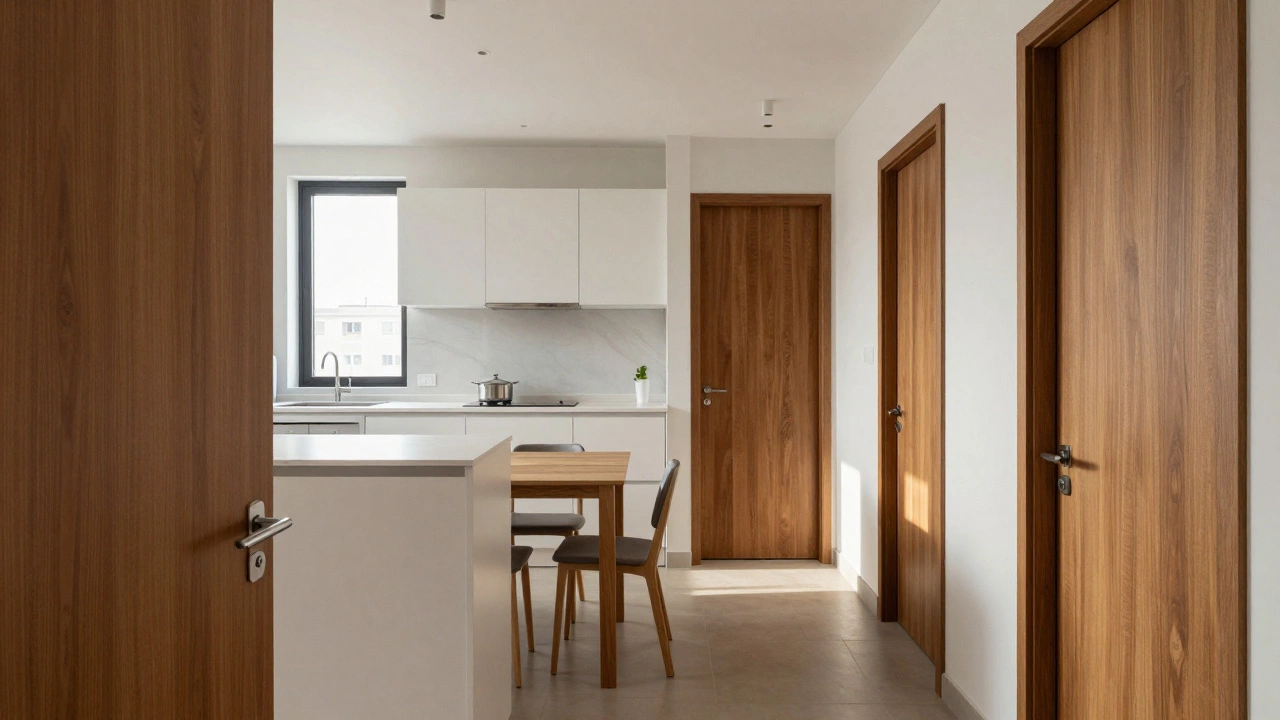
2DK vs. 2BHK Apartment Suitability Calculator
Tell us about your needs:
Based on your inputs regarding privacy, hosting, and budget.
Select your preferences above to see which apartment layout fits your lifestyle best.
You are scrolling through property listings, and suddenly you see a term that stops you in your tracks: 2DK a housing layout featuring two bedrooms, a dining area, and a kitchen without a separate living room. You know what a 1BHK or 2BHK is. But 2DK? It sounds like a typo, yet it appears frequently in specific markets, particularly in Asia and increasingly in global real estate discussions about micro-living. If you are trying to figure out if this layout fits your lifestyle, you are not alone. The confusion is understandable because the terminology varies wildly depending on where you are looking.
In this guide, we will break down exactly what a 2DK apartment is, how it differs from the more common 2BHK (Two Bedroom Hall Kitchen), and why this specific layout might be the perfect solution for your space constraints-or a dealbreaker. We will look at the floor plans, the pros and cons, and who actually benefits from this setup.
Decoding the Acronym: What Does 2DK Stand For?
To understand the layout, you first need to decode the letters. In real estate shorthand, especially in countries like India, Japan, and parts of Southeast Asia, these acronyms describe the functional zones of a home. Here is the breakdown:
- 2: Two bedrooms.
- D: Dining area. This is usually an open space adjacent to the kitchen or integrated into the main living zone, but distinct from a formal living room.
- K: Kitchen. A dedicated cooking space, which may be enclosed or open-plan.
The critical missing piece here is the Hall. In a standard 2BHK a residential unit with two bedrooms, a hall (living room), and a kitchen, the "H" stands for Hall, which serves as the primary living room. In a 2DK, there is no separate, enclosed living room. The social space is combined with the dining area or exists only as a pass-through zone between the entrance and the bedrooms.
This distinction is vital. A 2DK is not just a smaller 2BHK; it is a fundamentally different spatial arrangement designed for efficiency rather than entertainment.
2DK vs. 2BHK: The Key Differences
If you are comparing listings, you need to know exactly what you are giving up and what you are gaining. The difference isn't just semantic; it affects daily life, furniture placement, and resale value.
| Feature | 2DK Apartment | 2BHK Apartment |
|---|---|---|
| Living Room | No separate living room | Dedicated Hall/Living Room |
| Dining Space | Integrated with kitchen or entry | Often separate or part of the Hall |
| Total Area | Compact (typically 500-700 sq ft) | Standard (typically 800-1100 sq ft) |
| Privacy | Lower; open flow between zones | Higher; defined rooms |
| Ideal For | Singles, couples, small families | Families, remote workers, entertainers |
| Maintenance Cost | Lower | Higher |
The most significant difference is the absence of the "Hall." In a 2BHK, the hall acts as a buffer. You can host guests, have a TV area, or create a workspace without disturbing the bedroom occupants. In a 2DK, the moment you enter, you are often in the same visual field as the dining table and the kitchen. There is less acoustic separation and less visual privacy.
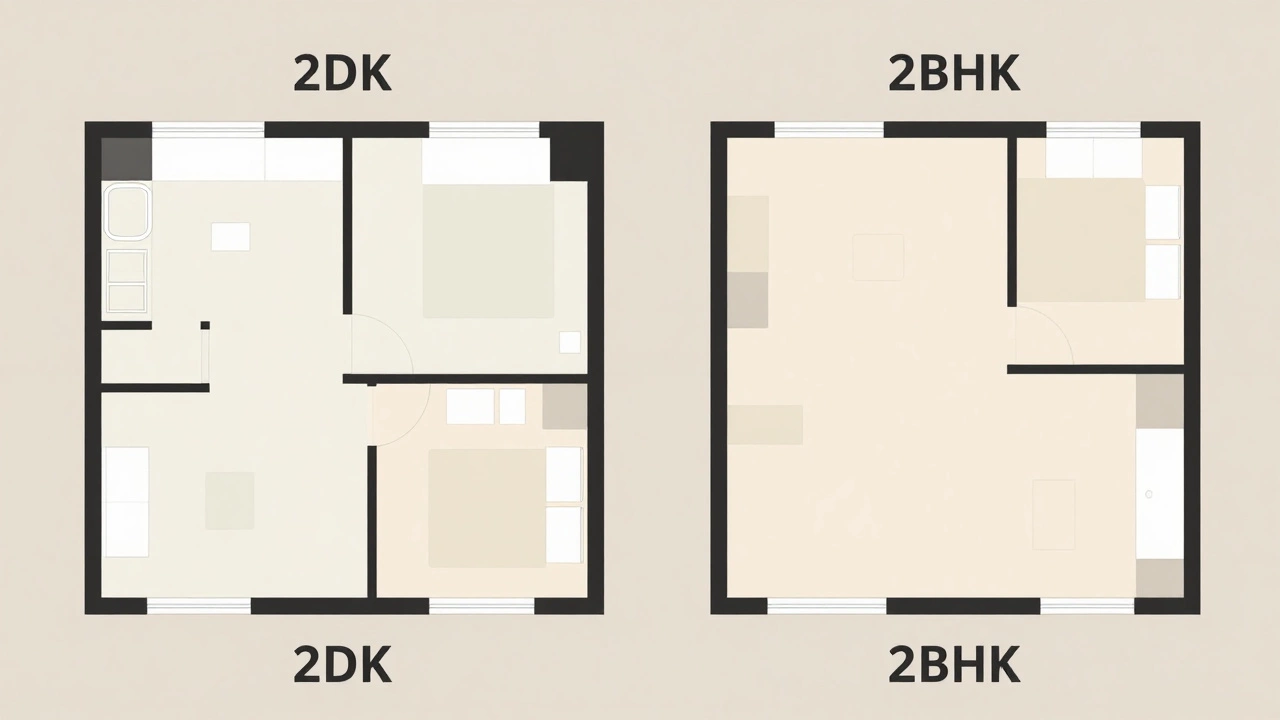
The Anatomy of a 2DK Floor Plan
Visualizing a 2DK helps demystify it. Imagine walking through the front door. Instead of entering a spacious foyer or living room, you step directly into a multi-functional zone. To your left might be the kitchen (Kitchen the area equipped for food preparation and cooking), and right next to it is a small dining table for two or four people. Behind you, or off to the side, are the doors to the two bedrooms and the bathroom(s).
Here is how the space typically functions:
- The Entry Zone: Often doubles as a mudroom or storage area since there is no hallway to waste space.
- The Core: The kitchen and dining area form the heart of the home. This is where you eat, chat, and spend time when not sleeping.
- The Bedrooms: These are usually standard-sized, providing private retreats. However, because there is no living room, one bedroom might occasionally serve as a guest room or office, while the other is the master suite.
- The Bathroom: Most 2DK units come with one full bathroom, though some premium versions include an ensuite for the master bedroom.
This layout forces efficiency. Every square foot must earn its keep. You cannot afford wasted corridor space. That is why 2DK apartments feel tighter but also more cohesive. You are always connected to the rest of the house.
Who Should Consider a 2DK Apartment?
A 2DK is not for everyone. If you love hosting dinner parties for ten people or need a quiet place to watch movies away from the kitchen noise, this layout will frustrate you. However, for certain demographics, it is a dream come true.
Couples and Young Professionals: If you live with one partner and rarely have overnight guests, you do not need a formal living room. You can use the dining area as a casual lounge with a sofa and a small TV. The second bedroom can be a home office, a gym, or a walk-in closet.
Small Families: Parents with one young child often find 2DKs sufficient. The child gets their own room, and the parents share the master. The open plan allows parents to keep an eye on the child while cooking or working at the dining table.
Budget-Conscious Buyers: Because 2DKs use less material and land per unit, they are often priced lower than 2BHKs. In high-cost cities, this price difference can be substantial, allowing buyers to enter the market sooner or upgrade to a better location.
Pros and Cons of Living in a 2DK
Before signing a lease or buying agreement, weigh these practical realities.
The Advantages:
- Cost Efficiency: Lower purchase price, lower rent, and lower utility bills due to smaller surface area.
- Easier Maintenance: Less space means less cleaning. You can vacuum the entire apartment in twenty minutes.
- Social Cohesion: The open layout encourages interaction. Family members stay connected rather than isolated in separate rooms.
- Flexibility: Without a fixed "living room," you can define the space based on your current needs-office today, playroom tomorrow.
The Disadvantages:
- Lack of Privacy: Noise travels easily. Cooking smells permeate the dining area. There is no place to retreat if you want solitude.
- Furniture Constraints: Standard-sized sofas and dining tables may not fit. You need custom or compact furniture.
- Resale Challenges: Some buyers strictly prefer traditional layouts. A 2DK may have a narrower pool of interested buyers compared to a versatile 2BHK.
- Guest Accommodation: Hosting friends for the night is awkward. You either sleep in the living/dining area or crowd into one bedroom.
Design Tips for Maximizing a 2DK
If you decide to go for a 2DK, smart design choices can make the space feel larger and more functional. Here are actionable tips:
1. Use Multi-Functional Furniture: Invest in a dining table that can expand or fold away. Consider a sofa bed for the main area instead of a permanent couch. This keeps the floor clear during the day.
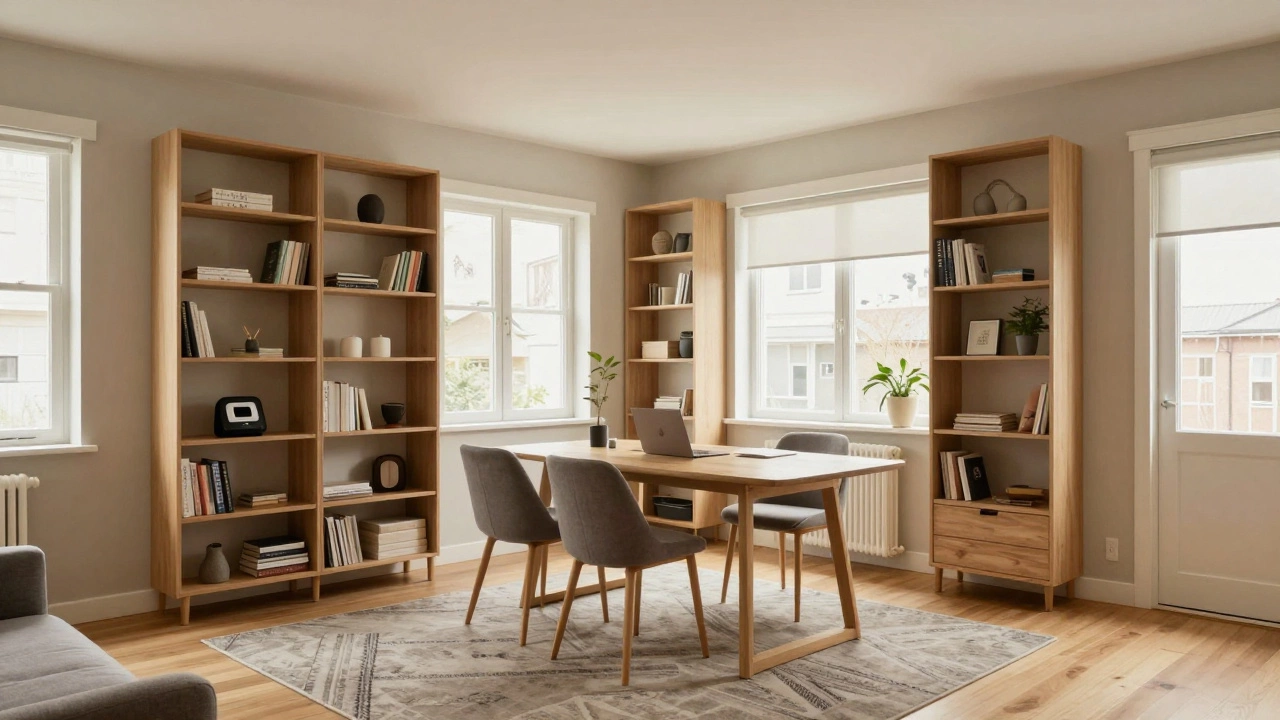
2. Vertical Storage: Since floor space is limited, build up. Install shelves up to the ceiling in the dining/kitchen area. Use under-bed storage in the bedrooms.
3. Light Colors and Mirrors: Paint walls in light neutrals to reflect light. Place mirrors opposite windows to create the illusion of depth. This is crucial in a layout without a deep hallway.
4. Define Zones with Rugs: Since there are no walls separating the dining area from the rest of the space, use rugs to visually anchor the dining table and another rug to suggest a seating area. This creates psychological boundaries without physical ones.
5. Glass Partitions: If the kitchen is open, consider glass sliding doors that can close when cooking strong-smelling foods but remain open otherwise to maintain the sense of space.
Is 2DK the Same as Studio or 1RK?
Confusion often arises between 2DK, studios, and 1RK (One Room Kitchen). It is important to distinguish them clearly.
A Studio Apartment a single-room dwelling combining living, sleeping, and cooking areas has no walls separating the bedroom from the living area. Everything is in one box. A 2DK, by contrast, has two distinct, walled-off bedrooms. This provides significantly more privacy than a studio.
An 1RK Apartment a unit with one main room serving as both living and sleeping space, plus a separate kitchen has one large room and a kitchen. A 2DK has two separate bedrooms. So, a 2DK offers more sleeping capacity and privacy than a 1RK, but less social space than a 2BHK.
Conclusion: Is a 2DK Right for You?
The 2DK apartment is a pragmatic choice for modern living. It strips away the excess of traditional layouts to focus on core needs: sleeping, eating, and cooking. If you value low maintenance, affordability, and simplicity, and you do not rely heavily on having a dedicated entertainment space, a 2DK can be a highly satisfying home. However, if your lifestyle involves frequent entertaining, working from home in a quiet environment, or raising a family with older children who need independence, you may find the lack of a hall limiting. Always visit the property, visualize your daily routine, and measure your essential furniture before committing.
What does DK stand for in apartment terms?
DK stands for Dining and Kitchen. It indicates that the apartment has a designated dining area and a kitchen, but lacks a separate living room or hall.
Is a 2DK bigger or smaller than a 2BHK?
A 2DK is typically smaller than a 2BHK. The absence of a dedicated living room (Hall) reduces the total square footage, making 2DKs more compact and efficient.
Can I convert a 2DK into a 2BHK?
It is difficult to convert a 2DK into a 2BHK without structural changes. You would need to partition the dining/living area to create a separate hall, which may reduce natural light and violate building codes. Consult a structural engineer before attempting any modifications.
Are 2DK apartments good for families?
2DK apartments can work for small families with one young child. The two bedrooms provide separate sleeping spaces. However, families with multiple children or teenagers may find the lack of a communal living area restrictive for study and leisure activities.
Where are 2DK apartments most common?
2DK layouts are very common in Japan, where space efficiency is prioritized, and in urban centers in India and Southeast Asia. They are becoming more popular globally as micro-apartments gain traction in expensive city markets.
Does a 2DK have a balcony?
Many 2DK apartments include a small balcony, often attached to the kitchen or the main living/dining area. However, due to the compact nature of the unit, balconies may be smaller than those found in 2BHK units.
How much does a 2DK cost compared to a 2BHK?
Prices vary by location, but generally, a 2DK costs 15-25% less than a comparable 2BHK in the same building or neighborhood. This makes it an attractive option for budget-conscious buyers or renters.